archon
The did:cid Method Specification
Abstract
The did:cid method specification conforms to the requirements specified in the DID specification currently published by the W3C Credentials Community Group. For more information about DIDs and DID method specifications, please see the DID Primer.
Introduction
The did:cid method is designed to support a P2P identity layer with secure decentralized verifiable credentials. DIDs created using this method are used for agents (e.g., users, issuers, verifiers, and nodes) and assets (e.g., verifiable credentials, verifiable presentations, schemas, challenges, and responses).
DID Format
DIDs using this method have the following format:
did-cid           = "did:cid:" cid-identifier
                   [ ";" did-service ] [ "/" did-path ]
                   [ "?" did-query ] [ "#" did-fragment ]
cid-identifier    = CID v1 in standard base32 encoding
Example
did:cid:bafkreiawdmk6fmqc5p237vffyctazpzdgvgqfdj2i3hx2idtodxkwhyj5m
DID Lifecycle
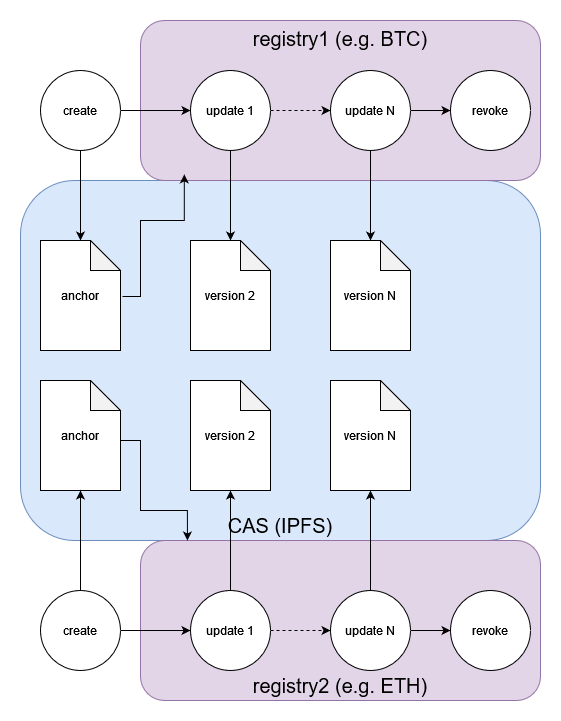
All did:cid DIDs begin life anchored to IPFS. Once created they can be used immediately by any application or service connected to a node. Subsequent updates to the DID (meaning that a document associated with the DID changes) are registered on a registry such as a blockchain (BTC, ETH, etc) or a decentralized database (e.g. hyperswarm). The registry is specified at DID creation so that nodes can determine which single source of truth to check for updates.
The key concept of this design is that DID creation is decentralized through IPFS, and DID updates are decentralized through the registry specified in the DID creation. The DID is decentralized for its whole lifecycle, which is a hard requirement of DIDs.
DID Creation
DIDs are anchored to IPFS prior to any declaration on a registry. This allows DIDs to be created very quickly (less than 10 seconds) and at (virtually) no cost.
The did:cid method supports two main types of DID Subject: agents and assets. Agents have keys and control assets. Assets do not have keys, and are controlled by a single agent (the owner of the asset). The two types have slightly different creation methods.
Agents
To create an agent DID, the client must sign and submit a “create” operation to a node. This operation will be used to anchor the DID in IPFS.
- Generate a new private key
- We recommend deriving a new private key from an Hierarchical Deterministic (HD) wallet (BIP-32).
- Generate a public key from the private key
- Convert to JWK (JSON Web Key) format
- Create an operation object with these fields in any order:
typemust be “create”registrationmetadata includes:versionnumber, e.g. 1typemust be “agent”registry(from a list of valid registries, e.g. “BTC”, “hyperswarm”, etc.)
publicJwkis the public key in JWK formatcreatedtime in ISO formatblockid[optional] current block ID on registry (if registry is a blockchain)
- Sign the JSON with the private key corresponding to the public key (this enables the node to verify that the operation is coming from the owner of the public key)
- The
proof.verificationMethodmust be set to#key-1(a relative reference) since the DID does not yet exist
- The
- Submit the operation to a node. For example, with a REST API, post the operation to the node’s endpoint to create new DIDs (e.g.
/api/v1/did/)
Example
{
    "type": "create",
    "created": "2026-01-14T19:29:06.924Z",
    "registration": {
        "version": 1,
        "type": "agent",
        "registry": "hyperswarm"
    },
    "publicJwk": {
        "kty": "EC",
        "crv": "secp256k1",
        "x": "LRrQabMIkvGVTA2IRk0JdWCpu57MNGm89nugrBZHo24",
        "y": "KHsWAaidAIGCosDjRYDIk-94793e4xVEL4UwFxjWgB8"
    },
    "proof": {
        "type": "EcdsaSecp256k1Signature2019",
        "created": "2026-01-14T19:29:06.927Z",
        "verificationMethod": "#key-1",
        "proofPurpose": "authentication",
        "proofValue": "qNT0EhtojDxOJBh71pddmWnMharQZJxOelW71ehFfuZqrqPls32zSP4bD2CyYNEvAXSJRA-3X5DwR1vHVyTPHw"
    }
}
Upon receiving the operation the node must:
- Verify the proof
- Apply JSON canonicalization scheme to the operation.
- Pin the seed object to IPFS.
The resulting content address (CID) in standard CID v1 base32 encoding is used as the DID suffix. For example the operation above corresponds to CID “bafkreig6rjxbv2aopv47dgxhnxepqpb4yrxf2nvzrhmhdqthojfdxuxjbe” yielding the DID did:cid:bafkreig6rjxbv2aopv47dgxhnxepqpb4yrxf2nvzrhmhdqthojfdxuxjbe.
Assets
To create an asset DID, the client must sign and submit a create operation to a node. This operation will be used to anchor the DID in IPFS.
- Create an operation object with these fields in any order:
typemust be “create”registrationmetadata includes:versionnumber, e.g. 1typemust be “asset”registry(from a list of valid registries, e.g. “BTC”, “hyperswarm”, etc.)
controllerspecifies the DID of the owner/controller of the new DIDdatacan contain any data in JSON format, as long as it is not emptycreatedtime in ISO formatblockid[optional] current block ID on registry (if registry is a blockchain)
- Sign the JSON with the private key of the controller
- The
proof.verificationMethodmust be the full DID reference of the controller (e.g.,did:cid:abc123#key-1)
- The
- Submit the operation to a node. For example, with a REST API, post the operation to the node’s endpoint to create new DIDs (e.g.
/api/v1/did/)
Example
{
    "type": "create",
    "created": "2026-01-14T19:32:24.354Z",
    "registration": {
        "version": 1,
        "type": "asset",
        "registry": "hyperswarm"
    },
    "controller": "did:cid:bagaaieradidcs4hohalzexldr5mdmbmt553tqq3ifqd56mvhifppvyfdc32q",
    "data": {
        "group": {
            "name": "testgroup",
            "members": []
        }
    },
    "proof": {
        "type": "EcdsaSecp256k1Signature2019",
        "created": "2026-01-14T19:32:24.375Z",
        "verificationMethod": "did:cid:bagaaieradidcs4hohalzexldr5mdmbmt553tqq3ifqd56mvhifppvyfdc32q#key-1",
        "proofPurpose": "authentication",
        "proofValue": "NGQMBq5venJ2i4F3-Uo0p_rEAlY0zr-YJeTTu7vUlZ0NfyqirIPISGGyy8KU-QrBvsCrfc0fsQm8sh-2BfAzqQ"
    }
}
Upon receiving the operation the node must:
- Verify the proof is valid for the specified controller.
- Apply JSON canonicalization scheme to the operation object.
- Pin the seed object to IPFS.
For example, the operation above that specifies an empty Credential asset corresponds to CID “z3v8AuahaEdEZrY9BGfu4vntYjQECBvDHqCG3mPAfEbn6No7AHh” yielding a DID of did:cid:z3v8AuahaEdEZrY9BGfu4vntYjQECBvDHqCG3mPAfEbn6No7AHh.
DID Update
A DID Update is a change to any of the documents associated with the DID. To initiate an update the client must sign an operation that includes the following fields:
- Create an operation object with these fields in any order:
typemust be set to “update”didspecifies the DIDdocis set to the new version of the document set, which must include any or all of:didDocumentthe main documentdidDocumentDatathe document’s datadidDocumentRegistrationthe protocol spec
previdthe CID of the previous operationblockid[optional] current block ID on registry (if registry is a blockchain)
- Sign the JSON with the private key of the controller of the DID
- Submit the operation to a node. For example, with a REST API, post the operation to the node’s endpoint to update DIDs (e.g.
/api/v1/did/)
It is recommended the client fetches the current version of the document and metadata, makes changes to it, then submit the new version in an update operation in order to preserve the fields that shouldn’t change.
Example update to rotate keys for an agent DID:
{
    "type": "update",
    "did": "did:cid:bagaaieradidcs4hohalzexldr5mdmbmt553tqq3ifqd56mvhifppvyfdc32q",
    "previd": "bagaaieradidcs4hohalzexldr5mdmbmt553tqq3ifqd56mvhifppvyfdc32q",
    "doc": {
        "didDocument": {
            "@context": [
                "https://www.w3.org/ns/did/v1"
            ],
            "id": "did:cid:bagaaieradidcs4hohalzexldr5mdmbmt553tqq3ifqd56mvhifppvyfdc32q",
            "verificationMethod": [
                {
                    "id": "#key-2",
                    "controller": "did:cid:bagaaieradidcs4hohalzexldr5mdmbmt553tqq3ifqd56mvhifppvyfdc32q",
                    "type": "EcdsaSecp256k1VerificationKey2019",
                    "publicKeyJwk": {
                        "kty": "EC",
                        "crv": "secp256k1",
                        "x": "hrpjLquejw7lOE2RVGr1LQ315k0JI1lwlI4WI3t983k",
                        "y": "G2_-Agy95QnIFzW5sa9Ik72vDPeqJ0rqqrxWs3CM49o"
                    }
                }
            ],
            "authentication": [
                "#key-2"
            ],
            "assertionMethod": [
                "#key-2"
            ]
        }
    },
    "proof": {
        "type": "EcdsaSecp256k1Signature2019",
        "created": "2026-01-14T19:29:16.117Z",
        "verificationMethod": "did:cid:bagaaieradidcs4hohalzexldr5mdmbmt553tqq3ifqd56mvhifppvyfdc32q#key-1",
        "proofPurpose": "authentication",
        "proofValue": "LEmM9NGL3b4WBzSUZVy0GOqzZ16KbGydBWfCwRNTmZV-ZRznm9g_09xIszITyB3y2A3DYYYaRp5E_tFegZgBgQ"
    }
}
Upon receiving the operation the node must:
- Verify the proof is valid for the controller of the DID.
- Verify the previd is identical to the latest version’s operation CID.
- Record the operation on the DID specified registry (or forward the request to a trusted node that supports the specified registry).
For registries such as BTC with non-trivial transaction costs, it is expected that update operations will be placed in a queue, then registered periodically in a batch in order to balance costs and latency of updates. If the registry has trivial transaction costs, the update operation may be distributed individually and immediately. This method defers this tradeoff between cost, speed, and security to the node operators.
DID Revocation
Revoking a DID is a special kind of Update that results in the termination of the DID. Revoked DIDs cannot be updated because they have no current controller, therefore they cannot be recovered once revoked. Revoked DIDs can be resolved without error, but resolvers will return a document set with the didMetada.deactivated property set to true. The didDocument and didDocumentData properties will be set to empty.
To revoke a DID, the client must sign and submit a delete operation to a node.
- Create an operation object with these fields in any order:
typemust be “delete”didspecifies the DID to be deletedprevidthe CID of the previous operationblockid[optional] current block ID on registry (if registry is a blockchain)
- Sign the JSON with the private key of the controller of the DID
- Submit the operation to a node. For example, with a REST API, post the operation to the node’s DID endpoint (e.g.
POST /api/v1/did/)
Example deletion operation:
{
    "type": "delete",
    "did": "did:cid:bagaaiera7vfnrxrmcvo7prrbmdhpvusroii4y2gir252nzk4jv5nxgkzldha",
    "previd": "bagaaiera7vfnrxrmcvo7prrbmdhpvusroii4y2gir252nzk4jv5nxgkzldha",
    "proof": {
        "type": "EcdsaSecp256k1Signature2019",
        "created": "2026-01-14T19:34:32.170Z",
        "verificationMethod": "did:cid:bagaaieradidcs4hohalzexldr5mdmbmt553tqq3ifqd56mvhifppvyfdc32q#key-1",
        "proofPurpose": "authentication",
        "proofValue": "YUTouPmhHDSudPSJ9iU44HdzBYDm7cqmDmanhgDLa4A3MBNiJpbWL2Db4BbzDYQ4NjJCRDWixYZOT2ojzzBHI3c"
    }
}
Upon receiving the operation the node must:
- Verify the proof is valid for the controller of the DID.
- Verify the previd is identical to the latest version’s operation CID.
- Record the operation on the DID specified registry (or forward the request to a trusted node that supports the specified registry).
After revocation is confirmed on the DID’s registry, resolving the DID will result in response like this:
{
    "didDocument": {
        "id": "did:cid:bagaaiera7vfnrxrmcvo7prrbmdhpvusroii4y2gir252nzk4jv5nxgkzldha"
    },
    "didDocumentMetadata": {
        "deactivated": true,
        "created": "2026-01-14T19:32:24Z",
        "deleted": "2026-01-14T19:34:33Z",
        "versionId": "bagaaierats6ttxvpx2l3tat25ota7z7335akfd2iup5loajsdlqcwismkgpq",
        "version": "2",
        "confirmed": true,
        "isOwned": false
    },
    "didDocumentData": {},
    "didDocumentRegistration": {
        "version": 1,
        "type": "asset",
        "registry": "hyperswarm"
    },
    "didResolutionMetadata": {
        "retrieved": "2026-01-14T19:36:09.115Z"
    }
}
The metadata has a deactivated field set to true to conform to the W3C specification.
DID Resolution
Resolution is the operation of responding to a DID with a DID Document. If you think of the DID as a secure reference or pointer, then resolution is equivalent to dereferencing.
Given a DID and an optional resolution time, the resolver retrieves the associated document seed from IPFS using the DID suffix as the CID, parsing it as plaintext JSON. If the data cannot be retrieved, then the resolver should delegate the resolution request to a fallback node. Otherwise, if the data can be retrieved but is not a valid seed document, an error is returned immediately. Once returned and validated, the resolver then evaluates the JSON to determine whether it is a known type (an agent or an asset). If it is not a known type an error is returned.
If we get this far, the resolver then looks up the DID’s specified registry in its document seed. If the node does not support the registry (meaning the node is not actively monitoring the registry for updates), then it must forward the resolution request to a trusted node that does support the registry. If the node is not configured with any trusted nodes for the specified registry, then it must forward the request to a trusted fallback node to handle unknown registries.
If the node does support the specified registry, the resolver retrieves all update records from its local database that are keyed to the DID, and ordered by each update’s ordinal key. The ordinal key is a set of values that can be used to sort the updates into chronological order. For example, the ordinal key for the BTC registry will be a tuple {block index, transaction index, batch index}.
The document is then generated by creating an initial version of the document from the document seed, then applying valid updates. In the case of an agent DID, a new DID document is created that includes the public key and the DID as the initial controller. In the case of the asset, a new DID document is created that references the controller and includes the asset data in the document metadata.
If there are any update operations, each one is validated by:
- verifying that the proof was created by the controller of the DID at the time the update was recorded,
- verifying that the previous version hash in the operation is identical to the hash of the document set that it is updating,
- verifying the new version is a valid DID document (schema validation).
If invalid, the update is ignored, otherwise it is applied to the previous document in sequence up to the specified resolution time (if specified) or to the end of the sequence (if no resolution time is specified). The resulting DID document is returned to the requestor.
In pseudo-code:
function resolveDid(did, versionTime=now):
    get suffix from did
    use suffix as CID to retrieve document seed from IPFS
    if fail to retrieve the document seed
        forward request to a trusted node
        return
    look up did's registry in its document seed
    if did's registry is not supported by this node
        forward request to a trusted node
        return
    generate initial document from anchor
    retrieve all update operations from did's registry
    for all updates until versionTime:
        if proof is valid and update is valid:
            apply update to DID document
    return DID document
Proof Verification
When verifying a proof on a credential or other signed object, the verifier must resolve the signer’s DID at the time the proof was created. This is essential for supporting key rotation - credentials signed with an old key must remain verifiable even after the signer rotates to a new key.
The proof.created timestamp serves two purposes:
- Records when the proof was made (audit trail)
- Anchors verification to the correct historical key state
In pseudocode:
function verifyProof(object):
    extract signerDid from proof.verificationMethod
    resolve signerDid at versionTime = proof.created
    get publicKey from resolved DID document
    verify signature using publicKey
    return valid or invalid
This temporal resolution ensures that a credential issued in 2020 can still be verified in 2030, even if the issuer has rotated keys multiple times since issuance.
Note: While the W3C Data Integrity specification makes proof.created optional, DID:CID requires it to support proper verification after key rotation.
Verification Method Format
The proof.verificationMethod field identifies which key was used to create the proof:
- Agent create operations: Must use relative reference
#key-1since the DID doesn’t exist yet (the proof is self-referential) - Asset create operations: Must use the full DID reference of the controller (e.g.,
did:cid:abc123#key-1) - Update/delete operations: Must use the full DID reference of the controller (e.g.,
did:cid:abc123#key-N)
DID Recovery
For security reasons, this method provides no support for storing private keys. We recommend that clients use BIP-39 to generate a master seed phrase consisting of at least 12 words, and that users safely store the recovery phrase.
If a user loses a device that contains their wallet, they should be able to install the wallet software on a new device, initialize it with their seed phrase and recover their DID along with all their credentials. This implies that a “vault” of the credentials should be stored with the agent DID document, though it should be encrypted with the DID’s current private key for privacy.